What Would Happen If Powerplay Rules in T20 Were Removed?
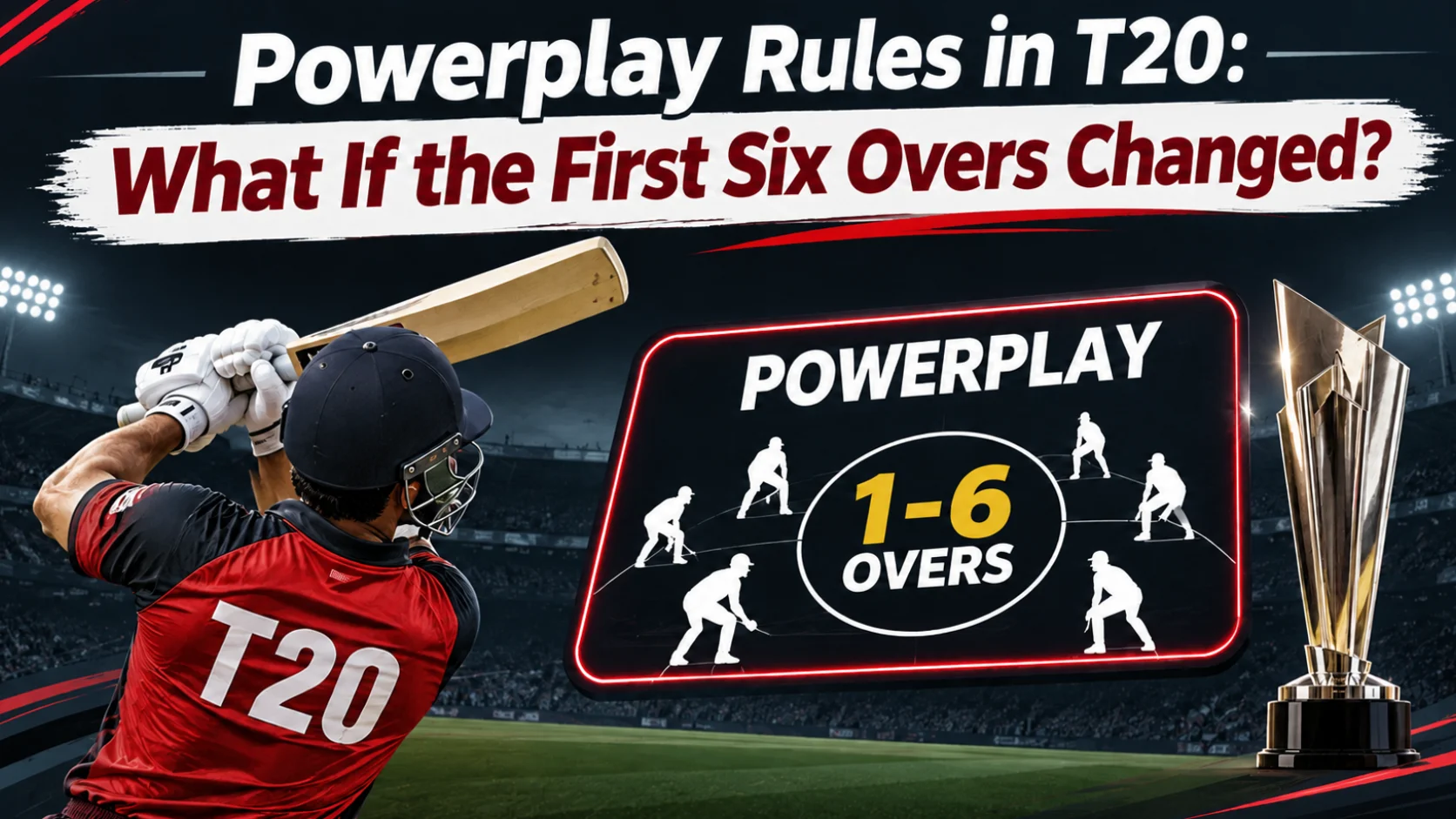
T20 Powerplay Rules control the first six overs of each innings. They require that only two fielders be kept outside the 30-yard circle by the fielding team during this period.
Without these rules, cricket will have more fielders around batters, and scoring will become difficult. This article explains those changes in simple words for readers of Playcricnews.
Understanding Powerplay Rules in T20
What the rules say now
The first six overs of the entire 20 over T20 game constitute the Powerplay. In Powerplay overs in cricket, there can only be two players outside the circle while the ball is being bowled.
Once the first six overs are over, the fielding captain can retain as many as five fielders outside the circle. As a result, the field quickly expands beyond this phase.
The circle uses two half circles built around the stumps at each end. In men’s T20 matches, each half circle has a 30-yard radius, joined by straight lines.
Why these rules matter
T20 fielding restrictions give batters a short time to attack without facing a fully spread field. As a result, openers often use the first six overs in T20 to build quick momentum.
Also, bowlers must bowl fuller lengths because fewer fielders guard the boundary. Therefore, swing, pace, and smart changes of pace become very useful during this phase.
How Batting Would Change
Slower starts would become normal
Without Powerplay Rules in T20, captains could place five fielders outside the circle at once. Therefore, batters would see fewer gaps and more boundary fielders from the first ball.
Teams would likely stop using bold opening plans. Instead, they would focus on safe singles, quick running, and saving wickets for the later overs.
Also, the value of a strong top order would drop. Middle-order batters who can hit over the ring later would matter more than fast-scoring openers.
Boundaries would become harder
Right now, batters use the open field during the first six overs in T20. However, a packed outfield would turn good shots into singles rather than fours.
As a result, dot balls would rise in the early overs. Wider lines could be used by bowlers since batsmen had fewer areas to score from safely.
Thus, runners and shot selection had to improve. A single would become useful, while a boundary would need perfect timing or great power.
How Bowling Would Change
More control for bowlers
Removing T20 powerplay rules would give bowlers more early control. Captains could guard the boundary at once and make batters take risks against a spread field.
As a result, swing bowlers would gain a big edge. A moving ball plus five boundary fielders would make batting very hard in the opening overs.
Moreover, the spinners could open up their bowling. They could go flat and wide since any bad shot wouldn’t be likely to beat the fielders.
Fewer early wickets, but more pressure
Oddly, bowlers might take fewer wickets early even with more control. Batters would avoid big shots and lower their risk of losing wickets.
However, pressure would build through dot balls. Later, batters would need to attack, and that is when wickets could fall in groups.
Therefore, bowling plans would focus on pressure rather than early breakthroughs. Captains would save their best bowlers for the time when batters must speed up.
How Captains Would Adapt
New field settings
T20 cricket fielding rules now limit early outfield placement. Without them, captains would use creative fields from the very first over.
On the other hand, those who could act as catchers from a nearby position would be able to remain stationary in order to punish bad shots.
Different batting orders
The teams will probably choose adaptable hitters instead of just hitters. It is because a hitter who knows how to switch positions under pressure is more beneficial than a six-hitting specialist.
Also, finishers would carry a bigger role. Since early scoring would slow, the last five overs would decide most matches.
Therefore, teams would plan innings in a new way. The first ten overs might become a safe phase, while the last ten would become the main attacking period.
Impact on Match Results
Lower totals and closer matches
The biggest change would show in team totals. Without T20 fielding restrictions, early scoring would drop, and first-innings totals would likely fall.
However, chasing teams would face the same issue. Therefore, matches could become closer because both sides would find it hard to build early momentum.
Also, pitch conditions would matter more. A slow pitch would make scoring harder, while a flat pitch would still let strong hitters change the match later.
More focus on the last overs
The final overs would become the true deciding phase. Batters would save their energy and wickets for a time when the field is already spread.
In the current format, the last overs already matter a lot. Without a Powerplay, however, most big hitting would happen after the tenth over.
Therefore, death bowling skills would become vital. Bowlers who can bowl accurate yorkers, slower balls, and wide deliveries would control the final stage.
What Fans Would Notice
A different kind of thrill
The current opening phase creates instant energy because batters attack a field with less cover. Removing Powerplay Rules in T20 would replace that early burst with slower, tactical cricket.
Some fans would enjoy the battle between captain and batter. Others would miss the quick boundaries and bold hitting that make modern T20 cricket special.
Still, cricket would not lose all its thrill. Instead, the drama would move toward tense middle overs and explosive final overs.
A bigger role for all-rounders
All-rounders would gain more value in this format. A player who can bowl tightly early and bat calmly later would offer huge help.
Also, teams would need quick fielders who can cover large areas. Athletic fielding would matter more because captains would use the whole outfield from the start.
Therefore, squad balance would change. Teams would prefer complete cricketers over players who help in only one phase.
Would Removal Improve T20 Cricket?
Reasons to remove it
Some people say batters get too much early help under the current rules. They feel bowlers should get a fairer chance to defend totals from the first over.
Also, packed fields could reward skill. Placement, running, and shot choice would matter more than simple boundary hitting.
Reasons to keep it
Some believe that the current format ensures T20 remains interesting to watch. The first six overs add an element of urgency, which makes the format special.
Also, removing the rule could make early overs dull. Captains would use similar defensive fields, and batters would answer with similar safe plans.
As such, the present equilibrium appears to be working very effectively. The equilibrium allows the batters to attack while allowing bowlers to employ skill.
Final Thoughts
The elimination of Powerplay rules in T20 will bring about drastic changes to the shortest form of international cricket. Batters will bat at a slower pace, bowlers will dominate, and fielding will be reconsidered by all captains.
The first six overs would no longer belong to bold batters. They would rather be a battle between good bowling and solid batting.
Finally, T20 cricket will prevail, although it will not be the same again. The current regulations maintain the right balance, and without them, this type of game is going to become even slower and more defensive. Playcric believes this balance is one reason T20 cricket draws such a huge worldwide audience.