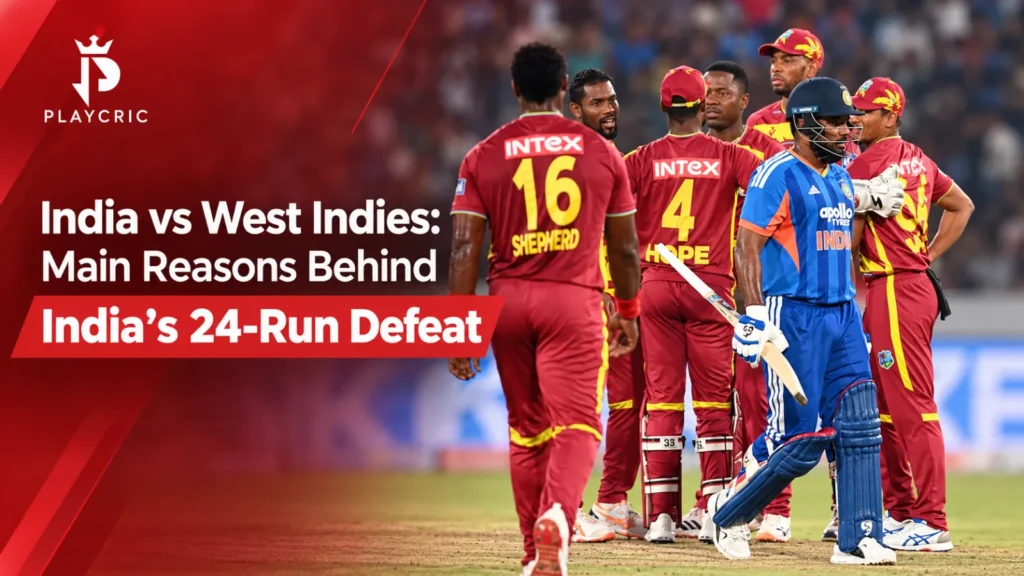
India vs West Indies: What Were the Main Reasons Behind India’s 24-Run Defeat?
India vs West Indies gave fans another high-scoring T20 match at Hyderabad on Wednesday evening. Shai Hope hit a superb unbeaten century, before Keemo Paul tore through India’s batting order.
India finished on 223 for nine and fell 24 runs short of West Indies’ huge total. West Indies reached 247 for three, and their late hitting made the target very hard. This result levelled the India West Indies T20 series at two matches each before the final match. Therefore, we must study the bowling, batting, and key moments to find why India lost against West Indies.
West Indies Set a Very Hard Target
Captain Shreyas Iyer chose to bowl first after winning the toss at the Rajiv Gandhi International Stadium. However, West Indies openers attacked boldly and reached 50 runs without losing a wicket in three overs.
India’s bowlers then kept the scoring low for 12 straight overs, but West Indies still built a big total. Shai Hope took 50 balls to get his century and remained not out at 102 runs. He made four fours and nine sixes, showing that he was fully in control of the game. Playcric looks at why India cricket team batters could not finish a tough chase against West Indies.
Hope and Rutherford Took the Match Away
Hope added an unbeaten 91-run stand with Sherfane Rutherford during the final overs of the innings. Rutherford made 49 not out from 26 balls and hit four fours plus three sixes. As a result, West Indies scored very fast at the end and moved past the 240-run mark.
India’s bowlers could not bowl tight lines or good lengths during this crucial stage of the match. Prince Yadav bowled well and took one wicket, but the other bowlers gave away too many runs. Moreover, India gave away 18 extras, and those runs mattered greatly in such a close match.
India’s Bowling Plans Did Not Work
India’s captain later said that poor bowling execution caused early problems for his team. The bowlers missed their lines, and West Indies batters hit every loose ball with confidence. Hope hit Nitish Kumar Reddy for two sixes on the last two balls of the innings. Therefore, West Indies finished strongly and posted a target close to the 250-run mark.
India’s fielding lineup also could not exert pressure because the batsmen managed to find holes in the fielding lineup. Hence, India required early wickets but was unable to break the partnership between the West Indies batsmen.
Also check how arshdeep singh changed the last match against West Indies
Sixes and Extras Made a Big Difference
West Indies hit 16 sixes, while India managed only 13 sixes during their reply. That gap added 18 runs, which matched the 18 extras India gave away during the first innings.
All Indian bowlers, except Prince Yadav, conceded more than 11 runs an over. Such small differences became significant as the winning margin of the match was only 24 runs. The India versus West Indies match highlights demonstrated the significance of late batting in Hyderabad.
India Started the Chase in Great Style
Sanju Samson gave India a fast start and scored 56 runs from only 23 balls. He hit four sixes and shared a quick 60-run opening stand with Abhishek Sharma. Abhishek made 29 runs as India reached 80 for two inside the first six overs.
At that point, India vs West Indies looked set for another huge run chase in Hyderabad. However, the required rate stayed very high because West Indies had made such a big total.
Middle-Overs Wickets Broke India’s Momentum
India lost wickets regularly after the powerplay and slipped to 130 for five in the middle overs. Keemo Paul removed key batters by mixing his pace well and attacking the stumps with skill. Gudakesh Motie also bowled tightly and took two wickets for only 13 runs.
Consequently, India could not build one long stand that could keep the required rate under control. Tilak Varma and Nitish Kumar Reddy then added 70 runs for the sixth wicket. Tilak scored 43 from 25 balls, while Reddy batted with intent during this useful recovery stand.
Tilak’s Dismissal Became the Turning Point
Sanju Samson later said that Tilak Varma’s dismissal was the most important moment of the chase. Tilak fell in the seventeenth over, when India needed one batter to stay until the end. Nitish Reddy also fell in the nineteenth over, leaving India with too many runs still needed.
Therefore, the lower order faced a nearly impossible task against West Indies’ confident bowling attack. Keemo Paul took five wickets for 41 runs and kept breaking India’s partnerships at key times. His slower balls and changes of pace troubled India’s batters as the pitch became slower.
Why India Lost Against West Indies
India lost because West Indies batted with more clarity during the final ten overs of the first innings. Hope and Rutherford accelerated brilliantly, while India’s bowlers could not execute their plans under pressure.
Furthermore, India gave away too many extras and allowed West Indies to clear the boundary more often. During the chase, Samson’s fast start raised hopes, but the middle order could not keep the momentum.
Paul’s five-wicket burst and Motie’s tight spell ensured India never controlled the required-rate equation. Consequently, India fell short despite a brave late fight from Tilak Varma and Nitish Reddy.
Key Reasons Behind the Defeat
- Shai Hope scored an unbeaten 102 from 50 balls and accelerated superbly at the death.
- Sherfane Rutherford made 49 not out and shared a rapid 91-run stand with Hope.
- India’s bowlers gave away 18 extras and struggled with their lines throughout the innings.
- Keemo Paul took five wickets for 41 runs and broke India’s partnerships at key times.
- Tilak Varma’s dismissal in the seventeenth over stopped India’s recovery during the chase.
- The pitch became slower and two-paced, which made boundary hitting harder in the second innings.
What India Must Improve Before the Decider
India must bowl tighter lines during the powerplay and death overs in the final match. The bowlers also need better variation because West Indies batters attacked predictable lengths with ease.
The batsmen need to build on good starts to form one solid partnership for the entire match. Samson demonstrated how fast India could bat, but his dismissal meant another collapse in the middle order.
For more such match updates and details, please visit Playcric.
Therefore, India cricket team batters must bat deeper and protect the lower order during tough chases. The final India vs West Indies match in Bengaluru will decide the five-match series outcome.