
How Did Arshdeep Singh Change the Momentum of the India vs West Indies Match?
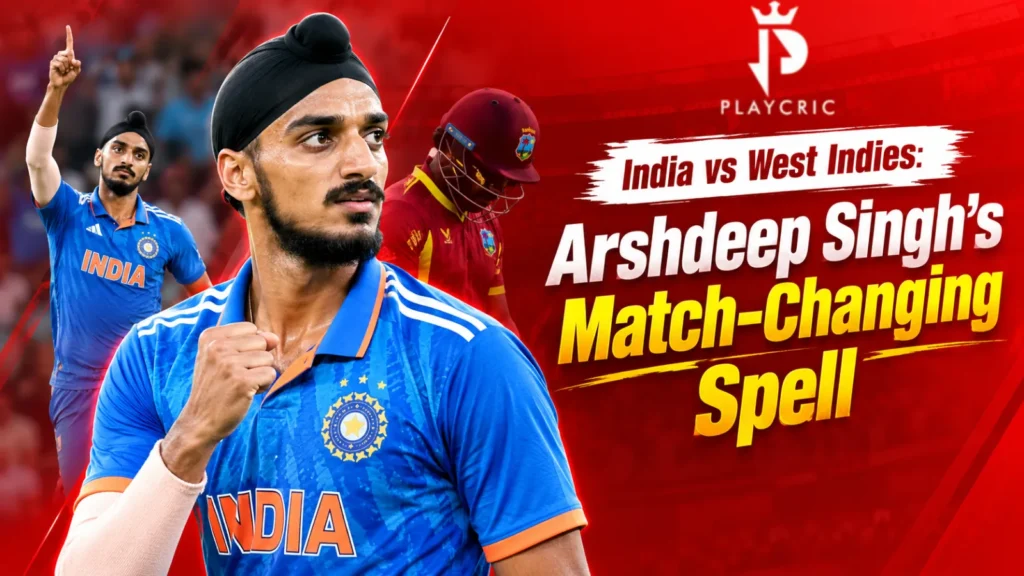
Arshdeep Singh changed the India vs West Indies match with smart and tight bowling. His early wicket removed Shai Hope and put pressure on the West Indies batters. Later, he took two more wickets in the eighteenth over and stopped their comeback. Therefore, Arshdeep truly became the key bowler in this high-scoring third T20I in Indore.
How the Match Started
India scored 223 runs after Abhishek Sharma hit 69 runs from just 30 balls. The India vs West Indies contest changed after Abhishek Sharma gave India a fast start. However, West Indies started their chase well because the Holkar Stadium pitch had low bounce.
Also, the visitors had many strong hitters who could score quickly in short bursts. So, the India cricket team needed early wickets to protect their big total of 223.
The IND vs WI contest needed early breakthroughs because both teams had deep batting lineups. Every IND vs WI match brings high energy, and this third T20I followed that pattern. Therefore, the bowling attack knew that early control would shape the entire chase.
Arshdeep’s Early Breakthrough
Arshdeep Singh bowled the second over and went straight after the West Indies captain. He bowled from around the wicket and used two fast yorkers to build pressure. Then, Shai Hope missed the next ball, and it crashed hard into the stumps. Hope scored just five runs, but leaving early affected West Indies’ top order badly.
Arshdeep Singh’s dismissals came at critical moments and stopped West Indies from building an effective partnership. As a result, Arshdeep gave India early control before the chase could gain any real speed. Besides, this wicket let India’s bowlers attack the new batters with much more freedom.
Why Hope’s Wicket Mattered
Shai Hope was in strong form and looked like the main threat early on. He could score fast and keep the scoreboard moving through quick and easy singles. However, Arshdeep removed him early before he could settle and fully control the chase.
As a result, the next batters faced pressure from the very start of their innings. Meanwhile, India’s bowlers and fielders gained confidence from this early success against a strong side.
Middle Overs and More Pressure
Shimron Hetmyer fought back bravely and made 43 runs from only 26 balls. Kamil Pooran also made 42 runs and briefly kept the required rate within reach. However, Naman Dhir removed both batters and broke the partnership at a key time. Also, Axar Patel removed Rovman Powell, which added more pressure on the remaining batters.
However, the India vs West Indies equation changed each time a partnership began to grow. Therefore, West Indies required one more alliance to revive their chase in the final overs. Sadly for them, India’s bowlers kept taking quick wickets whenever a recovery seemed possible.
The Key Eighteenth Over
Sherfane Rutherford and Keemo Paul tried to bring West Indies back into the match. However, Arshdeep then returned for the eighteenth over and took two very big wickets.
First, he removed Keemo Paul for 10 runs with a fast yorker at the stumps. Next, he removed Sherfane Rutherford for 32 runs and ended West Indies’ last real hopes.
After that, West Indies could not chase the target with enough batters left in hand. Indeed, this over turned a close match into a clear advantage for the hosts. Therefore, the India vs West Indies balance moved firmly toward the hosts after his over.
Strong Death Bowling
Arshdeep took three wickets while giving away 44 runs in his four over spell. Besides that, he bowled with great discipline despite the fact that the pitch was level and there were short boundaries. His fast yorkers gave the batters very little room to swing the bat freely. Similarly, Prince Yadav and Nitish Kumar Reddy helped him with tight bowling at the end.
Therefore, the whole bowling unit defended 223 successfully and secured a narrow 14-run victory. Indeed, Arshdeep’s calm bowling under pressure became the main reason for India’s strong defense. As a result, India kept West Indies to 209 for seven in their 20 overs.
What Made Arshdeep So Good
Arshdeep mixed his pace, length, and angles well during the toughest parts of the chase. For example, he used around-the-wicket angles against Hope and changed his length very smartly. Also, he saved his best balls for the times when West Indies looked to recover. His prowess in yorkers during high-pressure situations was what set him apart from others.
Most importantly, he adhered to his game plan rather than going for speed only. In addition, his calm attitude had a positive impact on the whole team of bowlers in times of high pressure. Likewise, his willingness to bowl difficult deliveries indicated self-belief in his abilities. Thus, Arshdeep gave a complete performance with his bowling.
Arshdeep’s Numbers
Arshdeep took three wickets for 44 runs at an economy rate of 11 per over. Moreover, he bowled two wides but still took key wickets when his team needed them. His opening wicket was taken in the second over itself, while the West Indies were still settling down to bat. His final two wickets were taken in the eighteenth over.
Thus, he has achieved the dual feats of getting an early wicket and then bowling calmly at the end. Also, his variations made the batters adjust again and again against a left-arm seam bowler. As a result, his spell became the base of India’s successful defense at Holkar Stadium.
How the Momentum Changed
The momentum changed first when Hope fell, as West Indies lost their most settled batter. Then, regular wickets stopped any partnership from becoming a truly long and dangerous chase. Finally, Arshdeep’s two wickets in the eighteenth over removed the last batters able to respond. Hence, the chase never found the rhythm needed to challenge the target of 224.
Besides, every wicket gave West Indies fewer options and made the required rate harder. Therefore, Arshdeep’s impact went beyond numbers and shaped the whole mood of the chase. Overall, Arshdeep influenced the India vs West Indies match at the start, middle, and end.
Lessons for Both Teams
India learned that tight death bowling can protect a big total on a flat pitch. But, they need to play well in their middle order batting, as they seem to lose steam once they get going.
For West Indies, they have to focus more on making partnerships than short bursts of hitting. Furthermore, the visitors needed better plans against yorker bowling in the last five overs.
Still, Hetmyer and Pooran showed that West Indies can chase big targets with brave batting. Overall, this close match showed the great value of pressure, planning, and smart execution.
Conclusion
India now leads the five-match T20I series 2-1 after this narrow victory in Indore. This India vs West Indies victory came after India recovered from a defeat in Ranchi. Furthermore, the result showed how important death bowling still is in modern T20 cricket. West Indies cricket has talent, but poor partnerships cost the team dearly in this match.
Playcric readers can see that Arshdeep’s spell was a great lesson in pressure bowling. His showing proved that smart bowling often matters more than just bowling very fast. Therefore, Arshdeep’s role will remain central to all important talks about this memorable contest.














One Response